Why Does Brockley Have So Much Rubbish on Its Streets?
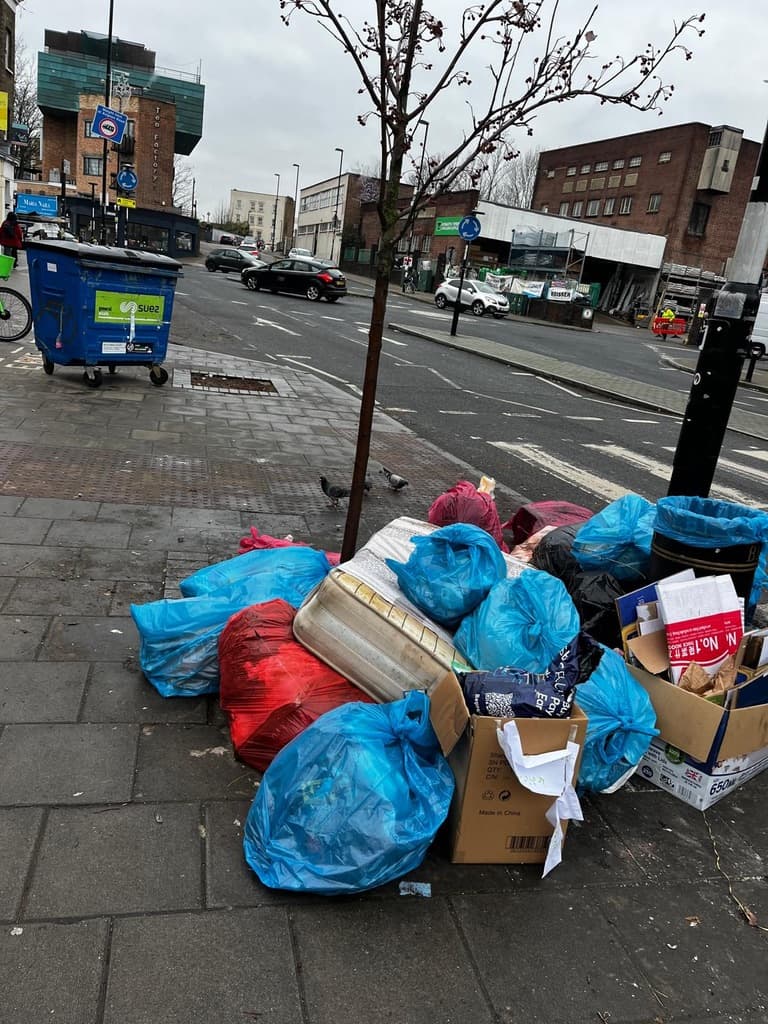
Bags, cardboard and a discarded mattress beside the pedestrian crossing at Brockley Cross
Fly-tipping in Lewisham rose sharply last year.
The borough recorded 27,599 incidents in 2023/24 and 33,471 in 2024/25, an increase of about 21% in one year. Lewisham now reports more than 43,000 incidents annually.[1][2]
That puts Lewisham at 111 incidents for every 1,000 residents, more than twice the London average of 53 and more than five times the England average of 21. Across England, fly-tipping rose by 9% in 2024/25, considerably less than the rise recorded in Lewisham.[1]
Lewisham also stands out beside neighbouring boroughs. Southwark recorded 59 incidents per 1,000 residents and Greenwich 56.[1]
These figures are not a perfect league table. Defra warns that councils record and classify incidents differently.[1] Lewisham's own total rose by nearly 6,000 in a year.
A political issue
Labour lost control of Lewisham Council in 2026.
Some voters linked fly-tipping directly to their decision. In a post-election discussion on r/lewisham, one contributor said they voted Green after their Labour councillors repeatedly failed to deal with fly-tipping, rat-running and speeding. The person who started the discussion agreed.[13]
The new Green-led council has put fly-tipping near the front of its public message. In August, an official council Instagram post said residents wanted CCTV and enforcement used against fly-tippers, and directed people to report dumped waste.[12]
Brockley Cross: when residents turn to petitions
At Brockley Cross and Geoffrey Road, residents have turned to a petition.
A petition started by residents in December 2024 describes overflowing rubbish, commercial food waste and frequent fly-tipping around the pedestrian crossing. It has attracted more than 1,000 verified signatures.[3]
Residents say bags of food waste, cooking oil containers and cardboard are left beside the pedestrian crossing and tree pit. Rats and foxes tear them open and spread rubbish along the pavement.[3]
It also describes a separate stream of fly-tipping at the same location, including mattresses, broken furniture, construction bags, mirrors and old fixtures. Residents say the combination can produce piles of waste that they encounter almost daily.[3]
The petition calls for proper commercial waste storage, regular inspections, stronger enforcement and more frequent street cleaning. It also asks for trees and planters.[3] The demands go beyond faster collection and call for changes to how the space is managed.
Giving problem spaces a new purpose
Breakspears Mews was once particularly badly affected by dumping. Brockley Society records how residents, council officers, police, tenants and volunteers removed 450 dumped tyres, nine abandoned vehicles and large quantities of rubbish. Part of the space later became Breakspears Mews Community Garden.[4]
After the clearance, part of the mews gained a clear use and a group of people who maintained it.
Nearby Coulgate Street changed when through traffic was removed. The community garden, café tables and public seating spread into space previously occupied by cars. That combination also makes fly-tipping harder: there is less vehicle access for unloading bulky waste, and more daily activity around places that were once quiet and neglected.
Residents on Sandrock Road are exploring something similar. In the local I Love SE4 Facebook group, a resident described a cul-de-sac repeatedly affected by fly-tipping. Neighbours want to create a community garden with planters and a hedge, giving the space a different purpose and making it harder to unload rubbish.[5]
Like the campaigns at Brockley Cross and Breakspears Mews, the Sandrock Road proposal starts from the view that repeated clearance leaves the underlying problem untouched.
In 2024/25, 62% of incidents involved household waste. Small van loads were the most common size, while single items such as furniture and mattresses accounted for 16% of incidents.[1]
The £5 experiment
Until December 2025, the council charged £42 to collect up to four large household items. It then cut the price to £5 per item, including mattresses. Fridges and freezers fell from £60 to £25.[6]
The council's current booking service confirms the £5 charge for mattresses and other large household items such as chairs, beds and sofas. Businesses cannot use the household collection service and must arrange their waste through licensed carriers.[7]
By June 2026, the council reported a 91% increase in bulky waste bookings, comparing September 2025 with May 2026.[2]
The increase in bookings does not show whether the lower price reduced fly-tipping. The borough's overall number of reports was still rising.
Residents can also take large items to the Landmann Way Reuse and Recycling Centre in New Cross. It is free and does not require a booking. Pedestrians and cyclists are allowed, but disposing of a mattress or sofa there is difficult without access to a car or van. Saturday access is also limited.[8]
The limits of bigger fines
In July 2026, the government announced that the maximum fixed penalty for fly-tipping would rise from £1,000 to £5,000.[9]
A bigger fine is useful only when someone can identify the person responsible.
Across England, councils carried out around 386,000 fly-tipping investigations in 2024/25 and issued 69,000 fixed penalty notices connected with fly-tipping and related waste offences.[1]
At Brockley Cross, the petition describes commercial waste and dumped household items repeatedly appearing in the same place. The test of enforcement is whether the source is identified and the dumping stops, rather than the maximum fine available.
More than 1,000 people have signed the petition about conditions around Brockley Cross, including specific complaints about commercial waste. It describes the problem as persistent rather than resolved.[3]
The public evidence does not show what enforcement action has been taken against individual businesses. Residents continue to report the same conditions.
A hotspot approach
The council's Cleaner Streets programme targets places where dumping repeatedly returns.
The Cleaner Streets delivery framework was approved in July 2026. Council teams will work together at persistent hotspots instead of handling each report in isolation.[10]
The programme provides up to £1 million in additional spending across 2026/27 and 2027/28. It includes targeted CCTV, additional crews, enforcement and closer coordination between waste, housing and community teams.[11]
The framework calls for monitoring clearance times and whether dumping returns after a hotspot is cleared.[11]
For Brockley, the new Green administration and the ward's three Green councillors will be judged on that result: fewer fly-tips, and fewer cleared sites filling up again.
Sources
- 1.^
Department for Environment, Food & Rural Affairs, Fly-tipping statistics for England, 2024 to 2025, 2026 — GOV.UK (Source archive)
- 2.^
Salamander News, Fly-tipping in Lewisham is getting worse, July 2026 — salamandernews.org (Source archive)
- 3.^
Brockley Cross and Geoffrey Road residents, Urgent action needed to improve conditions in Brockley Cross/Geoffrey Road, 2024 — change.org (Source archive)
- 4.^
Brockley Society, Brockley's Historic Mews, 2026 — brockleysociety.org.uk (Source archive)
- 5.^
I Love SE4 Facebook group, Sandrock Road community garden proposal, accessed August 2026 — facebook.com (Source archive)
- 6.^
Lewisham Council, Council reduces its bulky waste collection charge, October 2025 — lewisham.gov.uk (Source archive)
- 7.^
Lewisham Council, Bulky waste booking service, accessed August 2026 — forms.lewisham.gov.uk (Source archive)
- 8.^
Lewisham Council, Landmann Way Reuse and Recycling Centre, accessed August 2026 — lewisham.gov.uk (Source archive)
- 9.^
Department for Environment, Food & Rural Affairs, War on waste crime: hefty new fines for fly-tippers and litter louts, July 2026 — GOV.UK (Source archive)
- 10.^
Lewisham Council, Cleaner Streets Programme: Delivery Framework decision, July 2026 — lewisham.moderngov.co.uk (Source archive)
- 11.^
Lewisham Council, Cleaner Streets Programme: Delivery Framework, 2026 — councilmeetings.lewisham.gov.uk (Source archive)
- 12.^
Lewisham Council, Fly-tipping enforcement Instagram post, August 2026 — instagram.com (Source archive)
- 13.^
r/lewisham contributors, Why did we vote Green?, 2026 — reddit.com (Source archive)