Circa 1965
The artists who arrived on Manor Avenue
By Brockley Society
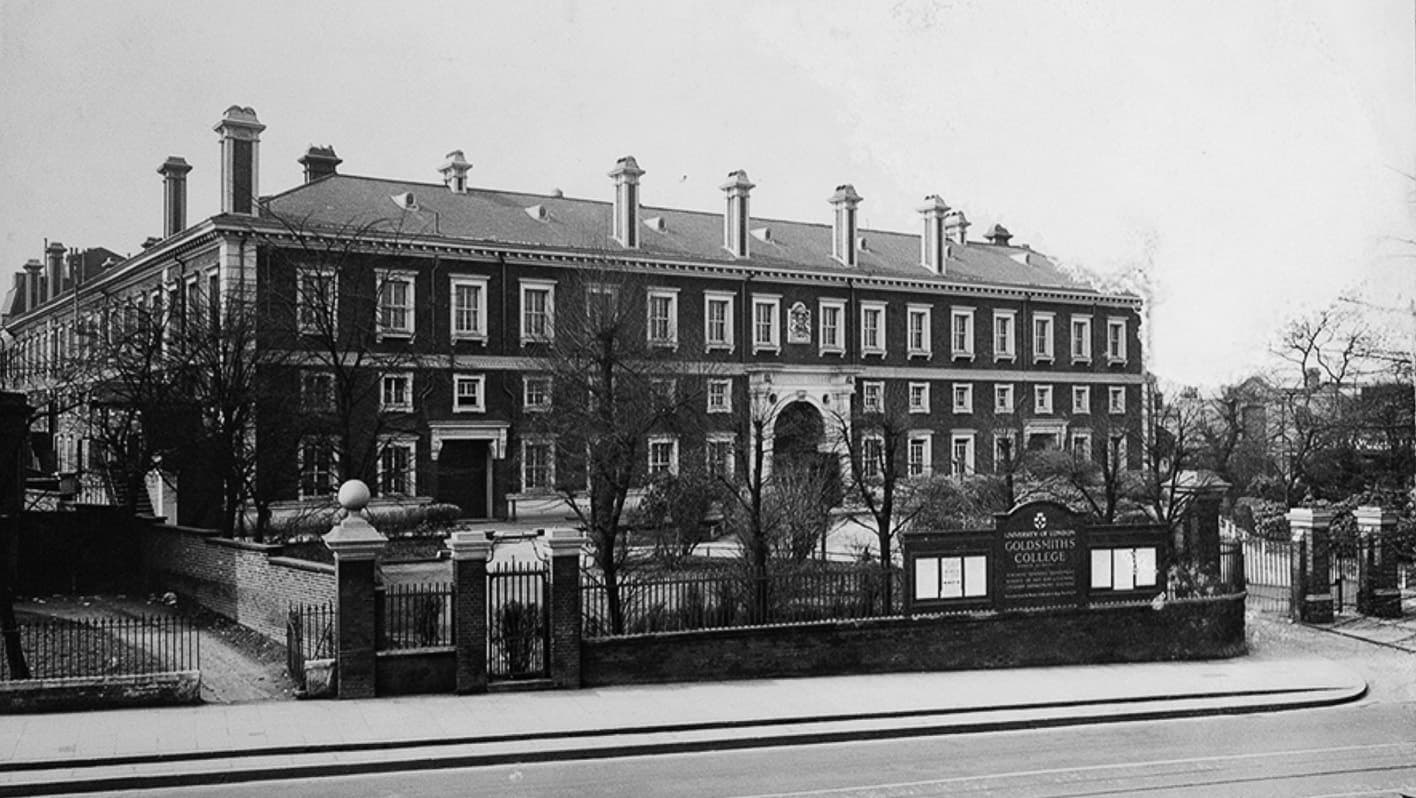
Goldsmiths College in New Cross, whose students and staff helped draw artists to Brockley from the mid-1960s
By the mid-1960s, Brockley's grand Victorian houses had fallen into quiet neglect. The wealthy families who built them had long gone, and many properties had been divided into flats. But the rooms were big and the prices were low. Into these houses, on one street in particular, came a wave of artists whose arrival would slowly change the whole area.[1]
A suburb in decline
Brockley's decline had been long in the making. Charles Booth's survey of London around 1900 had described residents of Wickham Road and Breakspears Road as "well-to-do" or "wealthy".[1] By the mid-twentieth century that prosperity had drained away. Wartime bombing scarred the area, and many larger houses were subdivided.[2]
As wealthier residents moved to the outer suburbs, the big houses were let out room by room, often to migrant workers who arrived from the Caribbean, Turkey, Cyprus, Italy and Sri Lanka.[2] In 1965, Brockley passed into the newly created London Borough of Lewisham.[2] Its Victorian streets, once a mark of status, were now seen as tired and unfashionable — and cheap.
Artists on Manor Avenue
From the mid-1960s, artists, some associated with nearby Goldsmiths College in New Cross, started to move into the large and neglected houses on Manor Avenue.[1] This is usually described as the beginning of the gentrification that continues today.[1]
They were drawn by space and price. The houses had rooms big enough to work in and gardens overgrown enough to build a studio in, and they could be had for what one account calls "now inconceivably low prices".[2] Brockley sat close to London's art schools, Goldsmiths and Camberwell School of Art among them, which made it a natural place for artists to settle.[1][2]
A bohemian reputation
The artists did not come alone. The mid-1960s brought what several accounts call a "bohemian" influx of writers, musicians and people living alternative lifestyles, attracted by the same cheap houses and rambling gardens.[1][2] Many of the neglected houses were restored, the gardens were tamed, and studios were built at the bottom of them.[2]
The reputation stuck. Writing in The Guardian in 2017, Tom Dyckhoff recalled a Brockley that in the late 1970s was "full of sociology students from Goldsmiths, bohemians and the scent of wacky baccy and rosebay willow herb".[3] He noted that gentrification had advanced but "has yet to overwhelm the place".[3]
From studios to conservation
The artists' interest in Brockley's architecture coincided with a fight to protect it. In 1974, much of north Brockley was designated a conservation area, and the Brockley Society was formed in the same year to preserve the character of the neighbourhood.[1] The result was one of the best-preserved Victorian suburbs in inner London.[1]
The creative community that took root in the 1960s endured. Local artists still open their homes each summer for the Brockley Open Studios weekend, the Brockley Max arts festival has run since 2004, and in 2015 the area held its first Brockley Street Art Festival, which produced more than twenty murals.[1]
A change that continues
What began on Manor Avenue spread steadily. Over the following decades Brockley drew a growing number of professionals and creative workers who renovated its Victorian houses and opened independent businesses.[1]
Gentrification has priced out some of the communities who lived in Brockley during its cheaper years, and estate-agent windows now tell a very different story from the one the first artists found.[3] The process that started with a handful of artists on a single street has run for more than half a century, one of south London's slowest changes of character.[1]
Sources
- 1.^
Brockley, Wikipedia — en.wikipedia.org/wiki/Brockley
- 2.^
The Sash Window Workshop, Brockley Victorian Suburb and Conservation Area — sashwindow.com
- 3.^
Tom Dyckhoff, Let's move to Brockley, south-east London, The Guardian, 28 July 2017 — theguardian.com