Circa 1940
Brockley under the bombs
By Brockley Society
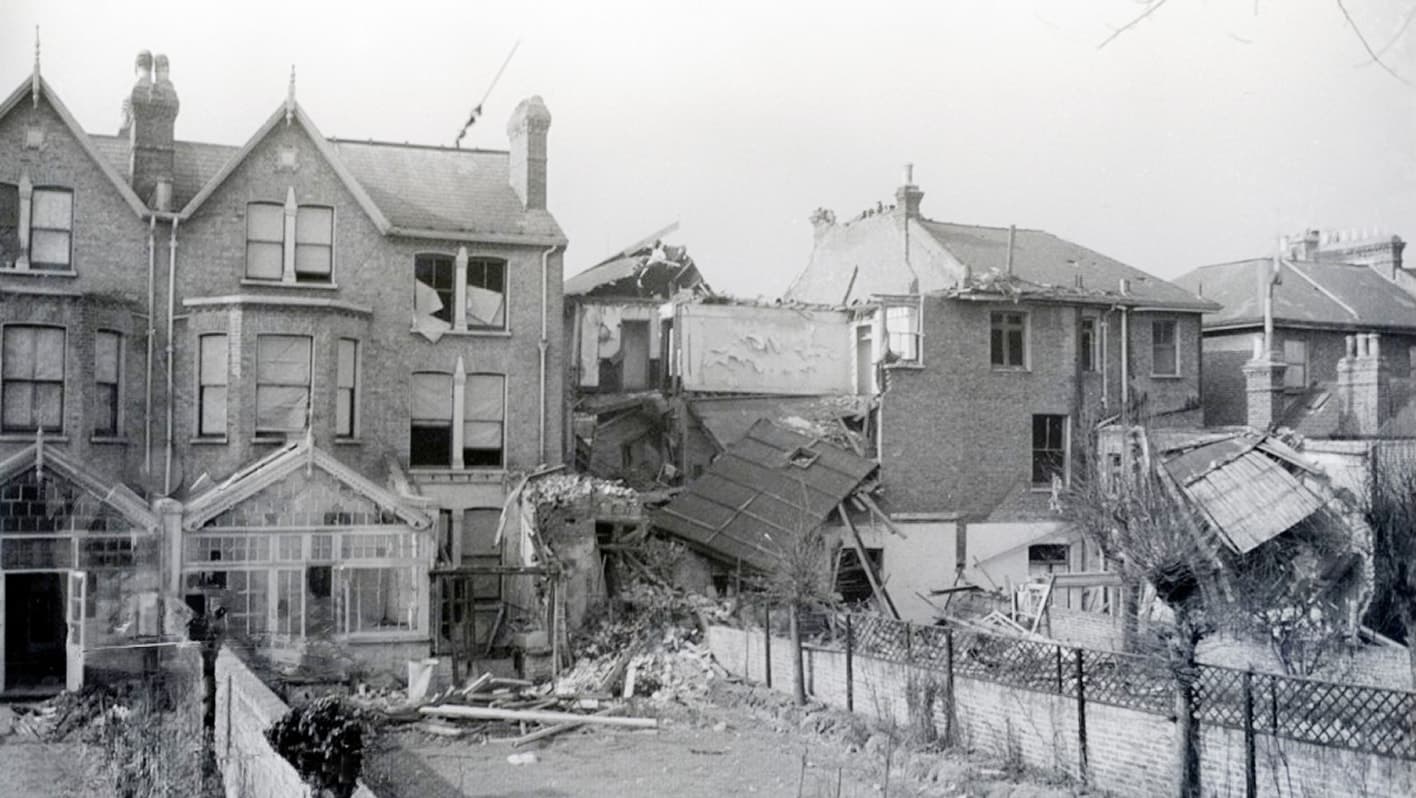
Bomb damage in Brockley during the Second World War
Under the railway bridge that crosses Brockley Road near Brockley Cross, the white tiles are pockmarked. The marks were left by a German aircraft that flew low over the street during the Second World War, firing its machine guns.[1] They are one of the few visible reminders of a war that reshaped Brockley more than any developer.
Under the flight path
Brockley sat beneath the bomber route to the London docks at Deptford and beyond.[2] That position brought heavy bombing. The area suffered significant V-2 rocket and other bomb damage, and whole houses were lost.[2]
The gaps are still legible on the ground. Where post-war blocks of council flats break a Victorian street, a bomb usually fell. The blocks at the south end of Wickham Road and the west end of Adelaide Avenue stand on ground the war cleared.[2] Local enthusiasts have traced the individual V-1 and V-2 incidents across SE4 on wartime bomb-damage maps.[3]
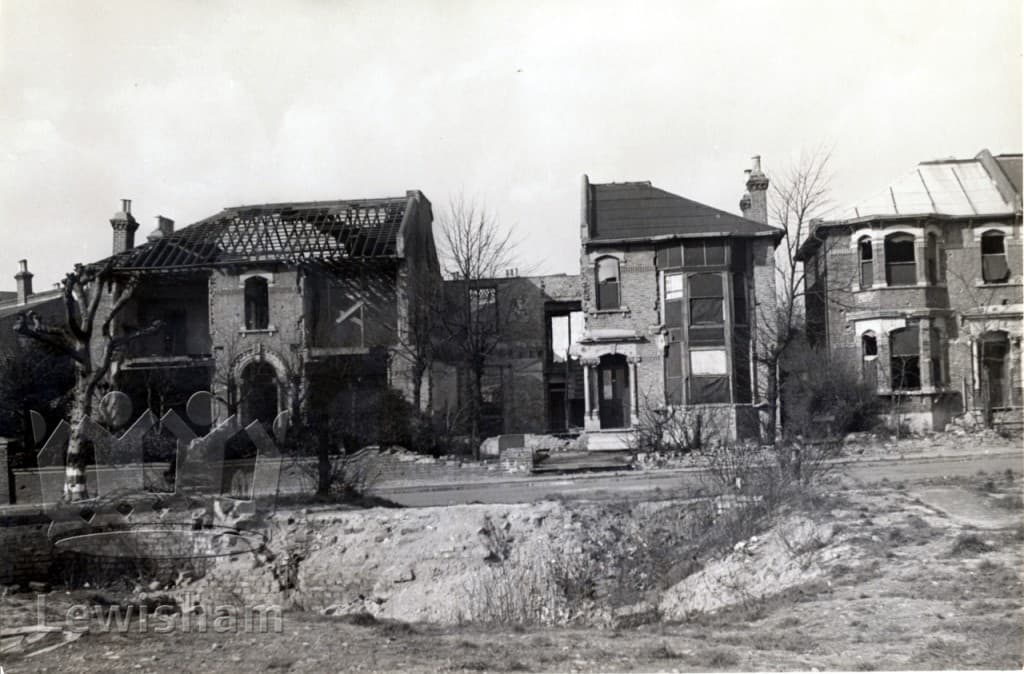
The bomb disposal crews were a regular sight. Lewisham's photographers recorded a squad clearing an unexploded device on Wickham Road, and in 1944 a 50kg phosphorus bomb was dug out of the front garden of 237 Brockley Road and burned out where it lay.[7]
The guns on Hilly Fields
Hilly Fields, the high ground that looks north across London, was put to military use. In 1942 a 4.7-inch anti-aircraft gun and its crew were stationed on top of the hill.[4]
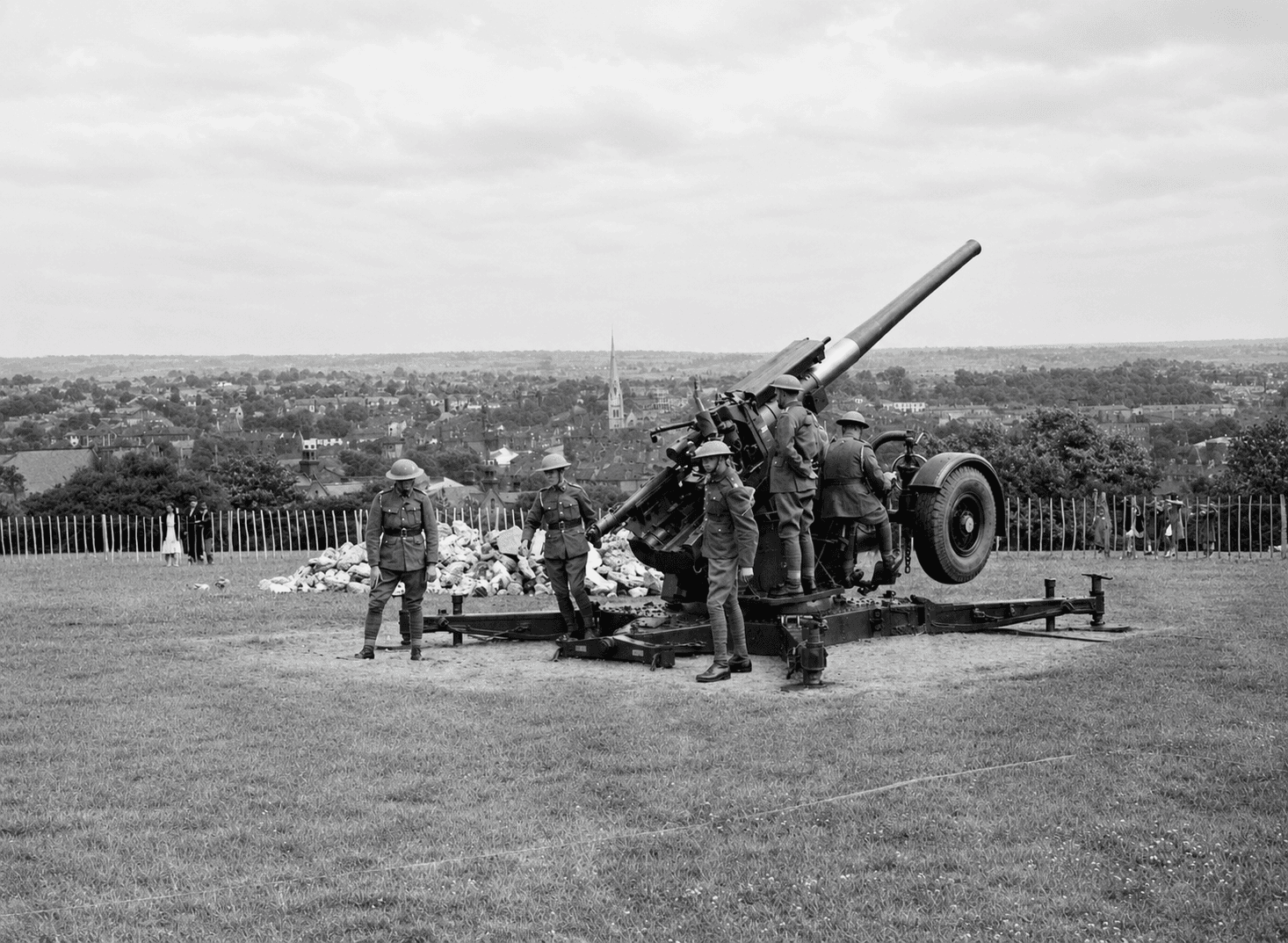
Nearby Telegraph Hill held another anti-aircraft battery.[1] Pieces of these defences survive in odd corners: part of an anti-aircraft battery is still embedded in a back garden on Pepys Road, too firmly set for anyone to shift.[5]
A schoolboy's near miss
The bullet holes at Brockley Cross have a witness. The novelist David Lodge, born in 1935, grew up at 81 Millmark Grove and walked home from school through the war.[1] One afternoon a German aircraft passed overhead and opened fire, its target said to be the battery on Telegraph Hill.[1] Some of the bullets struck the tiled wall under the railway bridge, and Lodge recorded that the pockmarks were still there when he looked about fifty years later.[1]
Counting the cost
The worst single attack fell just outside Brockley. On Friday 28 July 1944, a V-1 flying bomb exploded by the clock tower in Lewisham High Street, in the middle of a busy market.[6] The stalls outside Marks & Spencer, Woolworth's and Sainsbury's took the full force of the blast. Fifty-one people were killed and more than 200 seriously injured, in one of the worst V-1 attacks London saw.[6] A plaque outside the Marks & Spencer store marks the spot.[6]
What the war left
Peacetime rebuilding filled the bomb sites, but not in kind. Blocks of concrete and brick went up where villas and terraces had stood, breaking the Victorian streets in places.[2] When much of north Brockley was made a conservation area in 1974, part of the reason was to protect what the bombs had spared from being lost to redevelopment as well.
The war is quiet in Brockley now. It survives in the run of a post-war block among Victorian houses, in a lump of steel in a Pepys Road garden, and in the pockmarked tiles under the bridge at Brockley Cross.[1][5]
Sources
- 1.^
Nazi slugs lodged in Brockley Cross, Brockley Central, 3 December 2015 (quoting David Lodge) — brockleycentral.blogspot.com
- 2.^
St Andrew's Brockley, Our Story — standrewsbrockley.com
- 3.^
Bomb damage Brockley, Brockley Central, 19 March 2009 — brockleycentral.blogspot.com
- 4.^
Hilly Fields, Brockley: anti-aircraft gun, 1942, Catford and Lewisham - way back when (Facebook), 15 August 2021 — facebook.com
- 5.^
Brockley's last line of defence, Brockley Central, 3 December 2015 — brockleycentral.blogspot.com
- 6.^
New plaque in Lewisham commemorates V1 victims, Brockley Central / Lewisham Council, 5 August 2011 — brockleycentral.blogspot.com
- 7.^
Lewisham Borough Photos / Lewisham Local History and Archives, Breakspears Road – damaged houses (1940s) and Bomb dug out of garden, 237 Brockley Road (1944) — boroughphotos.org